Home / Guides / Aruba Beaches
Mangel Halto Aruba: Snorkeling Guide, Entries & Currents
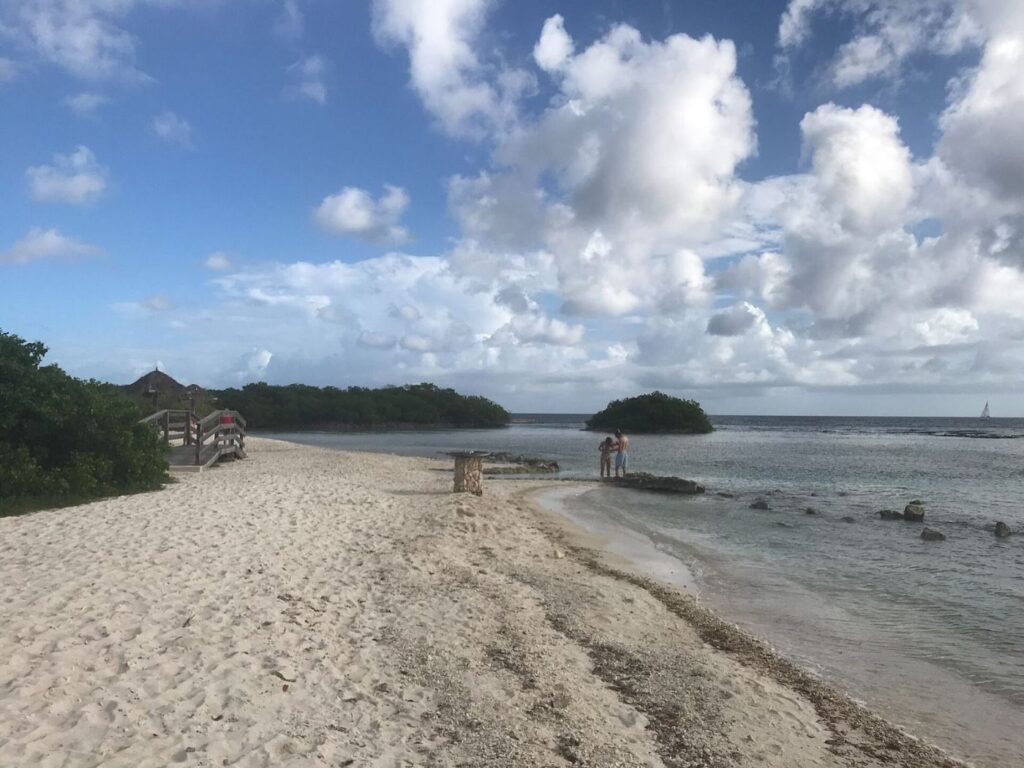
Mangel Halto Aruba is a shallow lagoon backed by mangroves in Pos Chiquito, on the south coast between Oranjestad and Savaneta. Inside the reef it’s calm and shallow, great for paddling and floating. Outside the reef is some of the best snorkeling on the island, with real coral and big schools of fish. It also has real currents and boat traffic. The trick is knowing which half of Mangel Halto you’re signing up for.
Where it is and how to get there
Drive south from Oranjestad on Route 1, past the airport, toward San Nicolas. It’s roughly 10 to 15 minutes from town. Mangel Halto sits just south of the Spanish Lagoon nature area. Snorkeling Report notes it isn’t well signposted, so use a map app. Tropical Snorkeling suggests following signs toward Marina Pirata restaurant, then parking along the rock walls near the Mangel Halto sign.
VisitAruba lists car or taxi as the ways in, and a car makes life easier if you are carrying snorkel gear.
What is there
- Public beach huts and shade along the road, popular for picnics.
- A wooden deck and dock area.
- Trash bins. Tropical Snorkeling found a portable toilet, but Snorkeling Report lists no public toilets, so don’t count on one. There are no public showers.
- Mangel Halto Bar is nearby.
- No lifeguard.
Weekends get busy with local families, so arrive early on a Saturday or Sunday if you want a hut.
Mangel Halto Aruba inside the reef: the easy part
The lagoon inside the reef is calm and shallow, with a sandy beach and paths through the mangroves. Families picnic here and kayakers and paddleboarders launch into the lagoon. Snorkeling inside the bay, to the left and right of the dock, shows you sand, rock patches, small corals and fish. That is manageable for beginners and kids who can swim.
In 2019 the area became a marine reserve within Marine Park Aruba, managed by the National Park Foundation. Treat it that way: no standing on coral, no feeding fish, no collecting.
Outside the reef: the good part, with conditions
Beyond the reef cuts, the coral is healthy and varied. Expect elkhorn, brain, star and fire coral, sea fans, French angelfish, blue tang schools, parrotfish, snapper and trumpetfish. The reef slopes off into much deeper water, which is why divers love it too.
It’s also exposed to the open sea, and both main snorkel sources say it’s not a beginner spot:
- Current: a current runs along the coast and pulls water quickly through the reef cuts. Tropical Snorkeling once couldn’t swim out through a cut because the flow was too strong.
- Coming back: exploring to the right means swimming back against that current. Only do it when the current is mild.
- Boats: small boats and motorboats use the deeper, buoy-marked cut to enter the bay quickly. Look before you cross. The shallower left cut sees less traffic.
- Distance: depending on where you enter, it can be 150 to 300 meters to the reef.
Snorkeling Report recommends only going out when there’s no wind, no waves and very little current. Don’t go alone, and stay close to the cuts so you can get back in. If surf is breaking in the cut, wait for another day.
Where to get in
| Entry | Pros | Cons |
|---|---|---|
| Wooden dock with ladder | Easy, sandy bottom, leave shoes on the dock | Longest swim to the reef, about 300 m |
| Cut through the mangroves | The entry Snorkeling Report recommends | Still about 200 m of finning |
| Sandy spot at the mangrove edge | Closest to the reef | Very shallow, sharp reef flat to cross, shoes needed |
For most people, the dock or the mangrove cut is the way to go.
The tugboat wreck
Divers also visit a small wreck nearby: the tugboat Kappel, lying at about 12 meters at a site Wikipedia lists as Mangel Halto, Tugboat. It is a dive rather than a snorkel for most people. If you want to see it, go with a local dive shop that knows the site and the boat lanes.
Visibility and timing
Visibility is generally good but clouds up when waves roll in. Morning is usually calmest. Check the wind before you leave the hotel. If the trade winds are howling, enjoy the lagoon and save the outer reef for another morning.
Combining it with other south-coast stops
Mangel Halto fits nicely on a south-coast day: morning snorkel here when it’s calm, lunch nearby, then on to Baby Beach for an afternoon float in the lagoon there.
Who Mangel Halto suits
- Families and beginners: the lagoon, the dock area and a picnic under a hut.
- Kayakers and paddleboarders: the mangrove channels.
- Strong snorkelers: the outer reef on a calm day, with a buddy.
It’s the best shore snorkel on Aruba when the sea lets you have it. Respect the current and the boat lane, and it’ll be a highlight of the trip.
Mangel Halto FAQ
Is Mangel Halto good for beginners?
Inside the lagoon, yes. Beginners should stay in the shallows near the dock. The outer reef is rated advanced by both snorkel guides we used.
Can you dive at Mangel Halto?
Yes. It is a well-known shore dive. The reef slopes into deep water, and the tourism board mentions octopus, moray eels and barracuda in the deeper sections.
Can I kayak or paddleboard there?
Yes. The tourism board mentions access through the mangroves for kayaking and stand-up paddleboarding, and the calm lagoon is ideal for it.
Are there showers or lifeguards?
No. Snorkeling Report lists no public showers and no lifeguard, so rinse off back at your hotel and never snorkel the outer reef alone.
What should I bring?
Mask, fins, water shoes for the rocky entries, a float or bright cap so boats can see you, and plenty of water.